

English sentences used in daily life help learners handle common conversations with natural and useful expressions. Daily conversations often include greetings, questions, requests, plans, family talks, shopping, meals, travel, and short social exchanges. Learning these sentence patterns makes it easier to understand what people say and respond appropriately. The sentences below use familiar words and everyday situations, with pictures and other learning aids suitable for practice.
You will learn Sentences Used in Daily Life for home, school, restaurants, transportation, phone calls, social plans, and everyday conversations. The examples also build practical sentence patterns that learners can use in spoken English.
Why Learn 1000 Sentences for Daily Use?
Learning many daily sentences gives learners repeated practice with common sentence patterns. It also helps connect familiar words with situations where those sentences naturally occur.
A large collection can include greetings, questions, answers, requests, directions, plans, feelings, routines, and short conversations. Practice each group gradually rather than trying to memorize thousands of sentences at once.
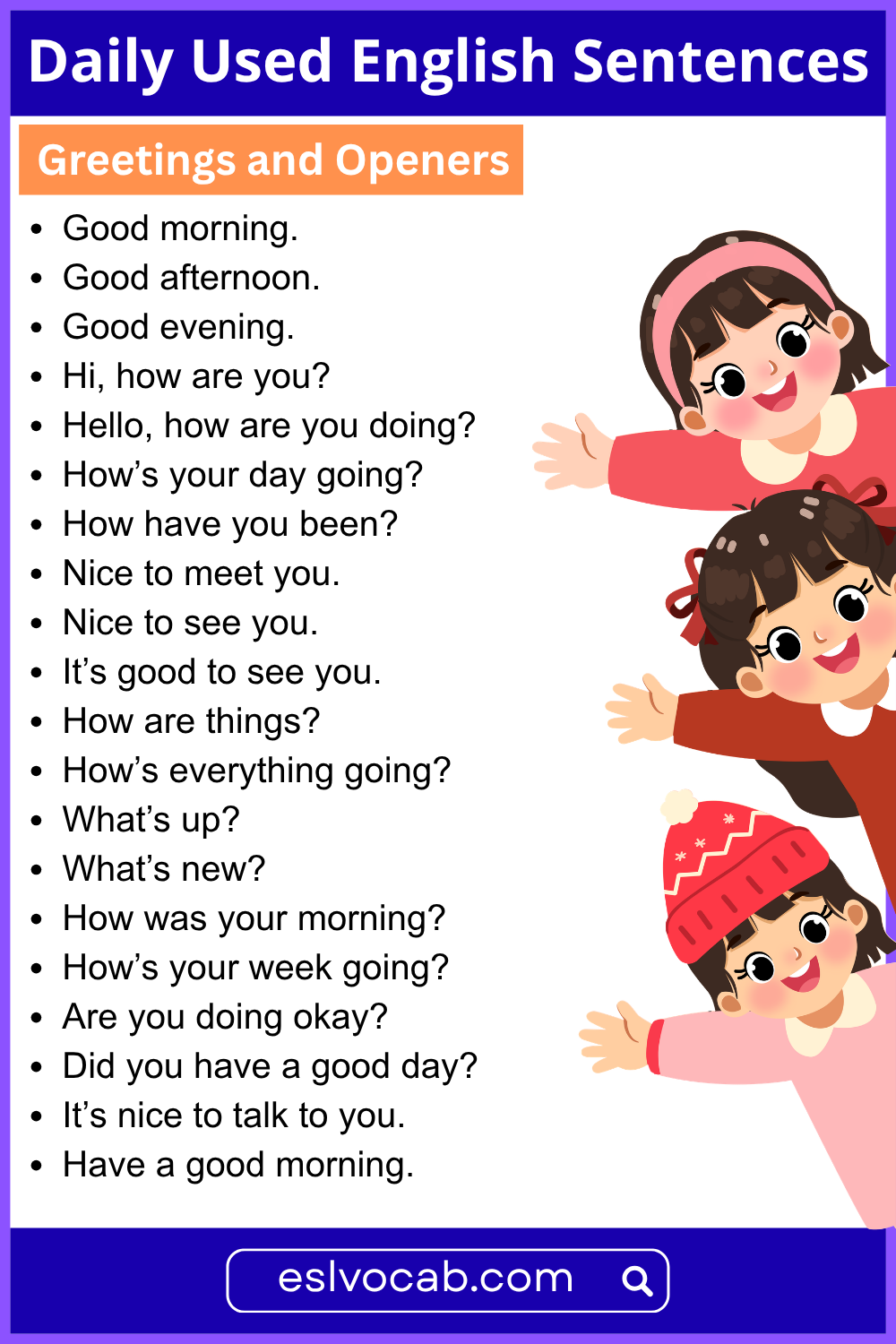
Greetings and Openers Sentences for Daily Use
Greetings begin many conversations, while short openers help you start talking naturally with friends, classmates, coworkers, neighbors, and other people.
- Good morning.
- Good afternoon.
- Good evening.
- Hi, how are you?
- Hello, how are you doing?
- How’s your day going?
- How have you been?
- Nice to meet you.
- Nice to see you.
- It’s good to see you.
- How are things?
- How’s everything going?
- What’s up?
- What’s new?
- How was your morning?
- How’s your week going?
- Are you doing okay?
- Did you have a good day?
- It’s nice to talk to you.
- Have a good morning.
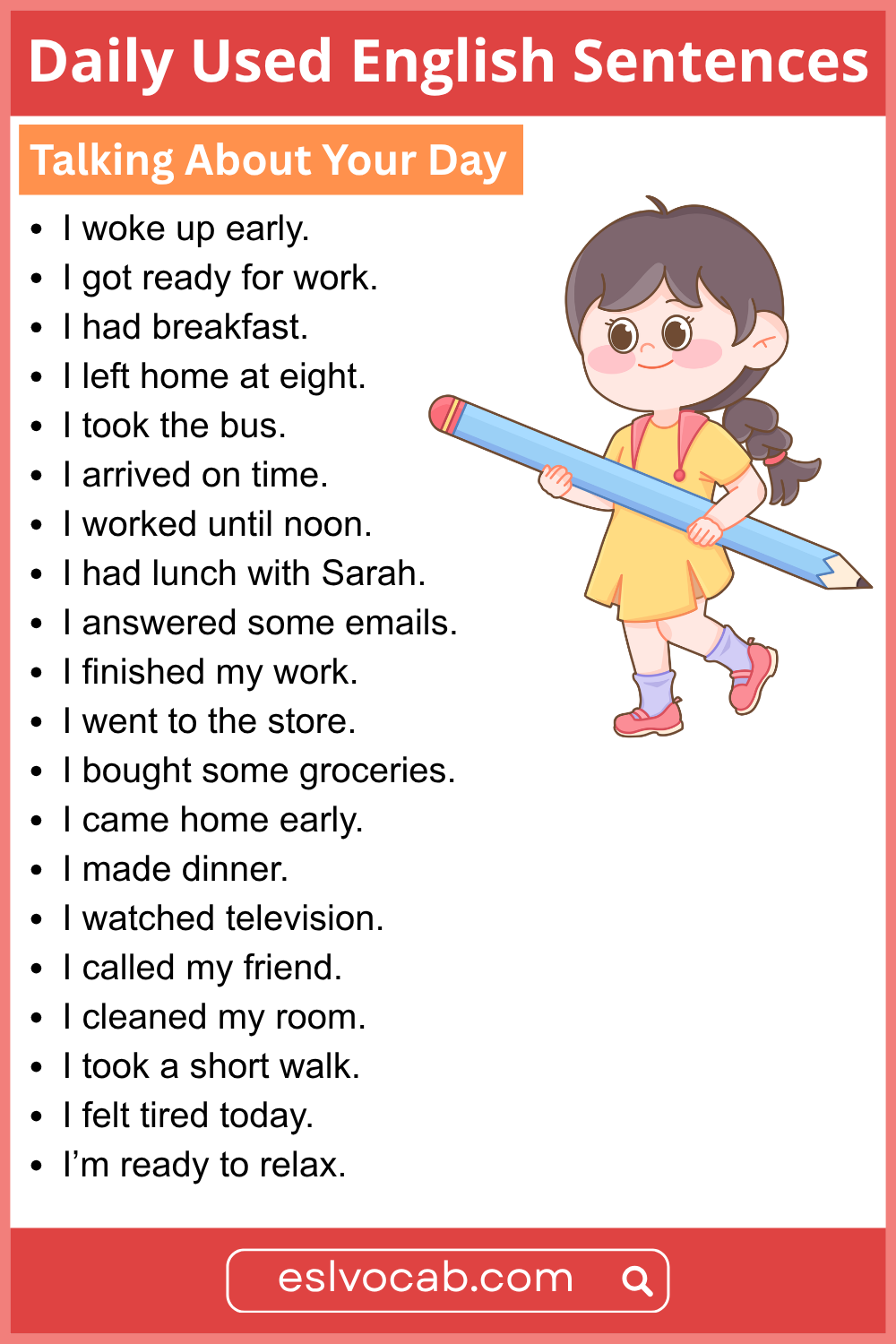
Talking About Your Day in English
Talking about your day usually involves routines, activities, meals, work, school, appointments, and feelings. Short sentences make these conversations easier to build.
- I woke up early.
- I got ready for work.
- I had breakfast.
- I left home at eight.
- I took the bus.
- I arrived on time.
- I worked until noon.
- I had lunch with Sarah.
- I answered some emails.
- I finished my work.
- I went to the store.
- I bought some groceries.
- I came home early.
- I made dinner.
- I watched television.
- I called my friend.
- I cleaned my room.
- I took a short walk.
- I felt tired today.
- I’m ready to relax.
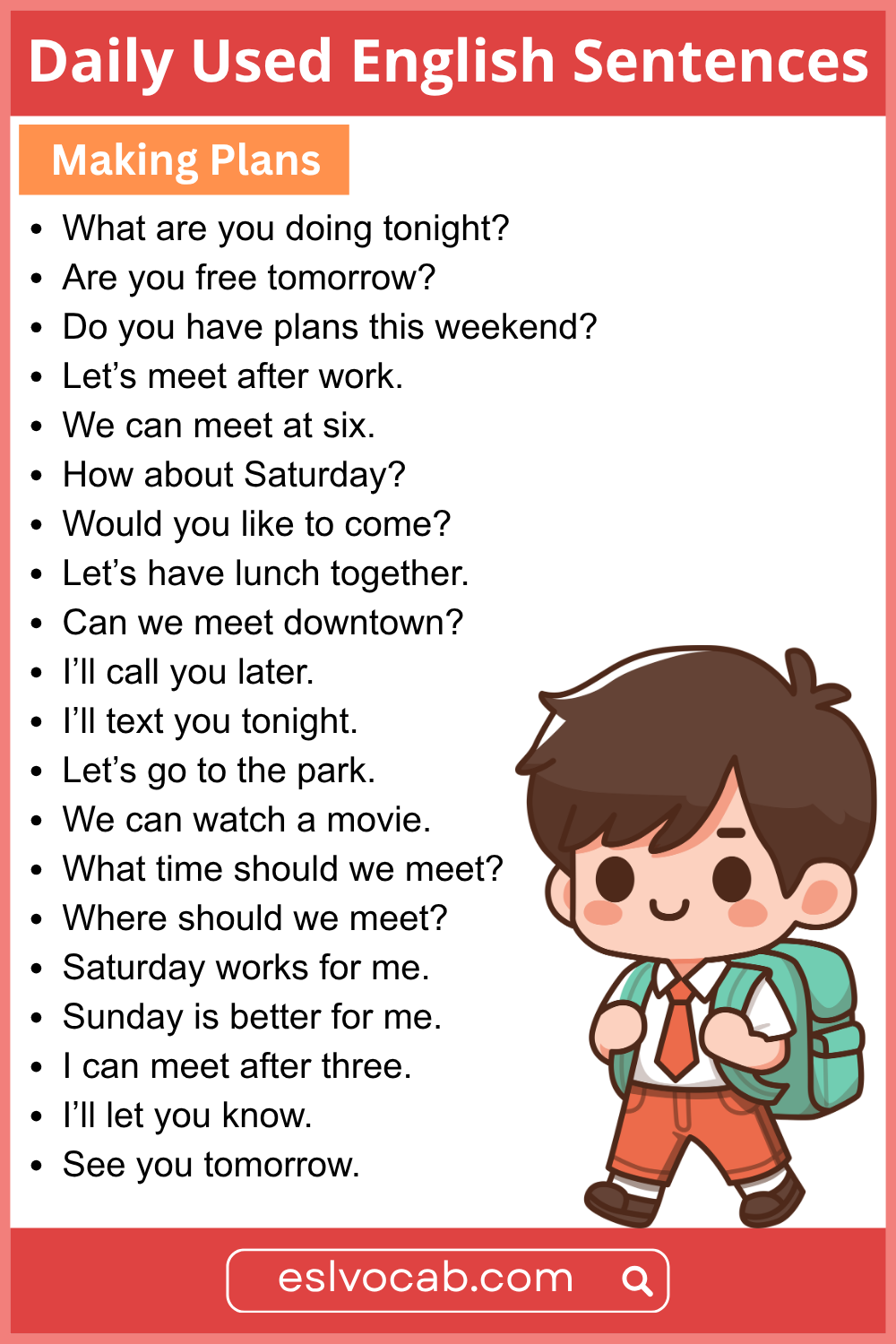
Making Plans in English
Plans often involve dates, times, places, activities, and people. These sentences help learners talk about what they want to do and arrange simple activities.
- What are you doing tonight?
- Are you free tomorrow?
- Do you have plans this weekend?
- Let’s meet after work.
- We can meet at six.
- How about Saturday?
- Would you like to come?
- Let’s have lunch together.
- Can we meet downtown?
- I’ll call you later.
- I’ll text you tonight.
- Let’s go to the park.
- We can watch a movie.
- What time should we meet?
- Where should we meet?
- Saturday works for me.
- Sunday is better for me.
- I can meet after three.
- I’ll let you know.
- See you tomorrow.
Talking About Yourself in English
Talking about yourself includes your name, home, work, school, interests, routines, and personal preferences. These short sentences help you introduce basic information naturally.
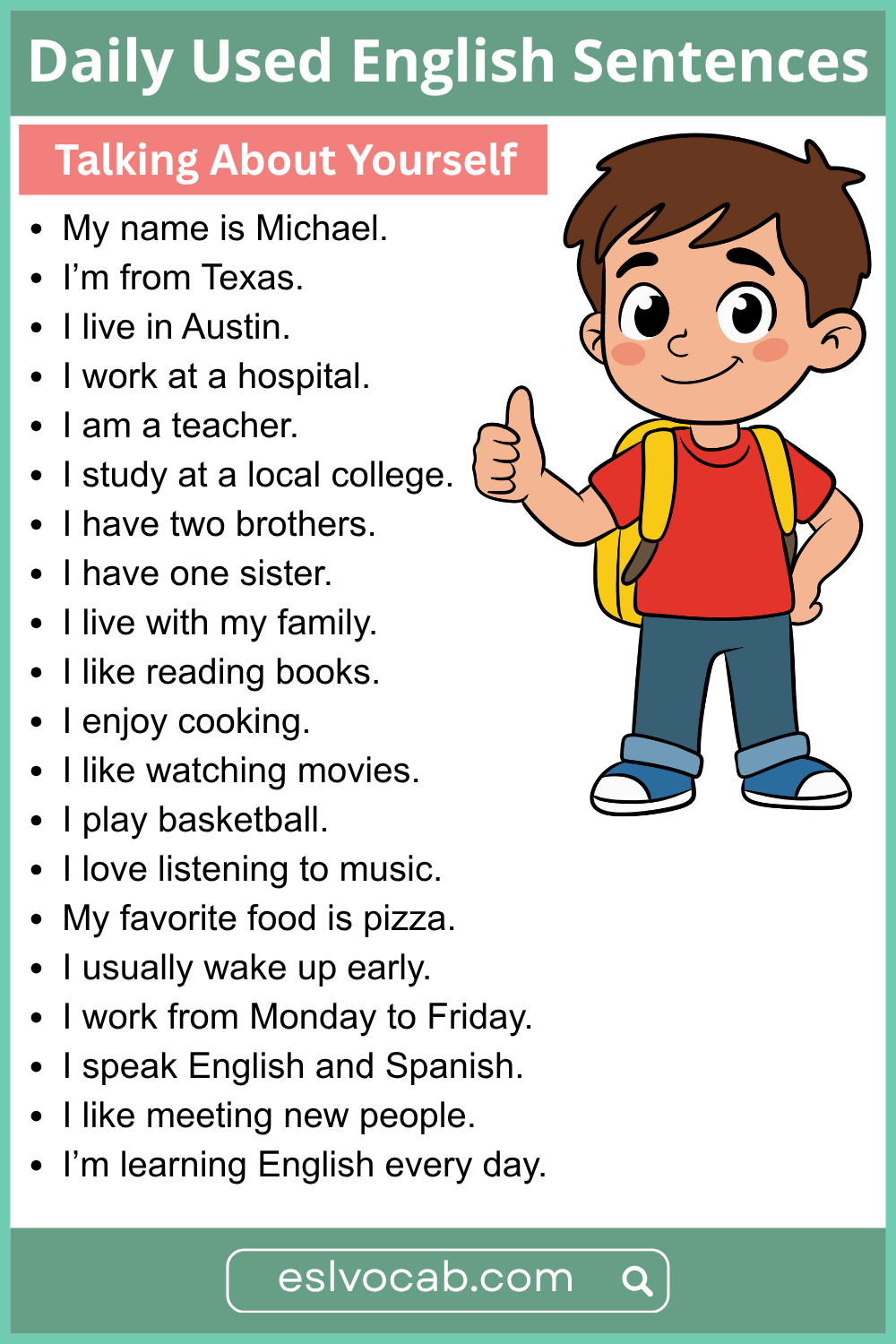
- My name is Michael.
- I’m from Texas.
- I live in Austin.
- I work at a hospital.
- I am a teacher.
- I study at a local college.
- I have two brothers.
- I have one sister.
- I live with my family.
- I like reading books.
- I enjoy cooking.
- I like watching movies.
- I play basketball.
- I love listening to music.
- My favorite food is pizza.
- I usually wake up early.
- I work from Monday to Friday.
- I speak English and Spanish.
- I like meeting new people.
- I’m learning English every day.
50 Positive English Sentences Used in Daily Life
Positive sentences express agreement, happiness, encouragement, thanks, hope, confidence, or satisfaction. The following sentences are short enough for regular conversation practice.
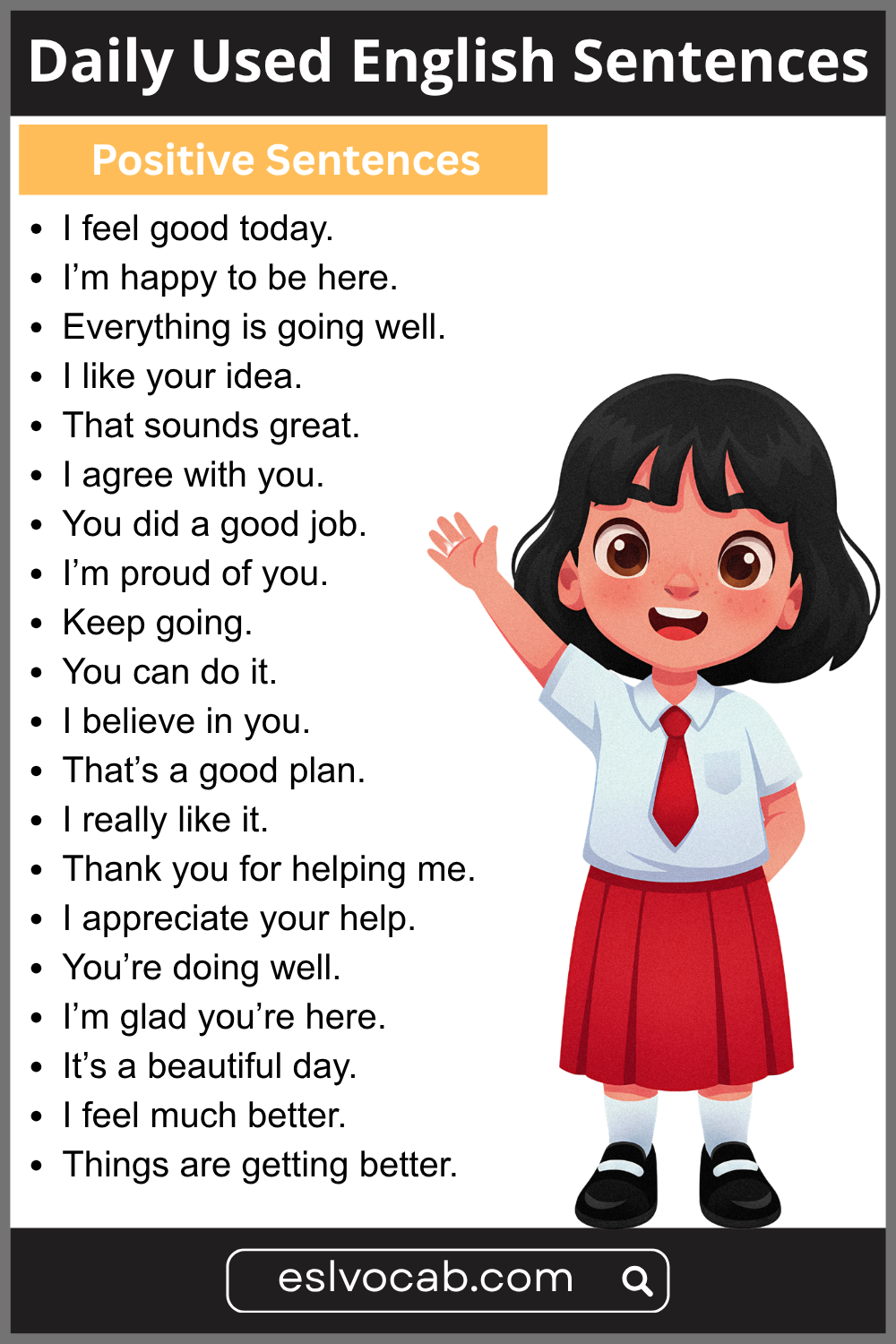
- I feel good today.
- I’m happy to be here.
- Everything is going well.
- I like your idea.
- That sounds great.
- I agree with you.
- You did a good job.
- I’m proud of you.
- Keep going.
- You can do it.
- I believe in you.
- That’s a good plan.
- I really like it.
- Thank you for helping me.
- I appreciate your help.
- You’re doing well.
- I’m glad you’re here.
- It’s a beautiful day.
- I feel much better.
- Things are getting better.
- I had a great day.
- The food tastes good.
- Your idea makes sense.
- I’m ready to begin.
- I’m happy with my work.
- That was a good choice.
- I enjoyed the movie.
- We had a nice time.
- I love this place.
- The room looks nice.
- This works for me.
- I’m glad we talked.
- That’s good news.
- I’m excited about tomorrow.
- I hope everything goes well.
- I’m feeling positive today.
- You made my day.
- Thanks for being here.
- I’m thankful for your help.
- Have a wonderful day.
Negative Sentences for Daily Conversations
Negative sentences help learners say that something is not true, available, possible, wanted, or happening. They commonly use words such as not, never, don’t, doesn’t, and can’t.
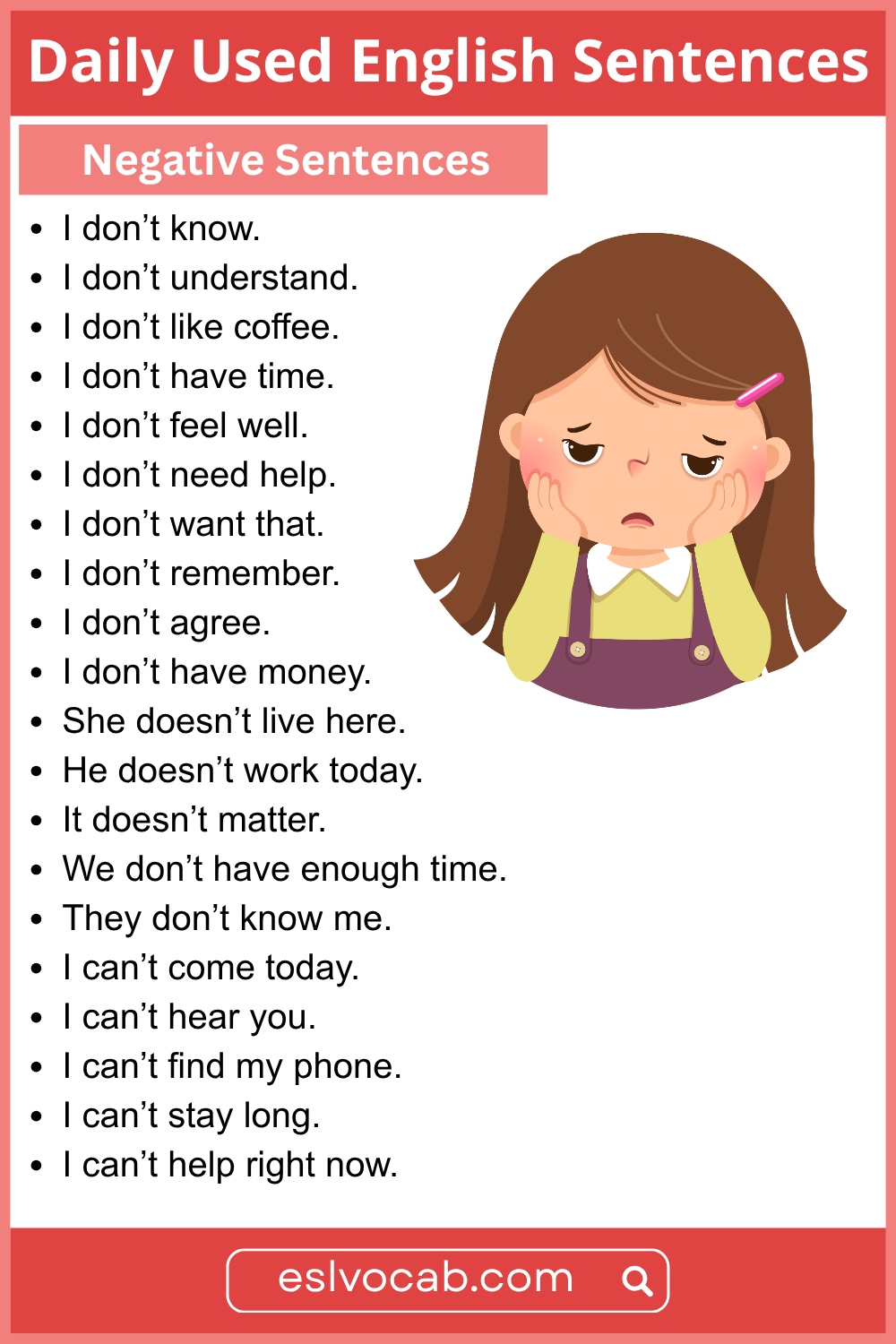
- I don’t know.
- I don’t understand.
- I don’t like coffee.
- I don’t have time.
- I don’t feel well.
- I don’t need help.
- I don’t want that.
- I don’t remember.
- I don’t agree.
- I don’t have money.
- She doesn’t live here.
- He doesn’t work today.
- It doesn’t matter.
- We don’t have enough time.
- They don’t know me.
- I can’t come today.
- I can’t hear you.
- I can’t find my phone.
- I can’t stay long.
- I can’t help right now.
- I’m not ready.
- I’m not busy.
- I’m not hungry.
- I’m not sure.
- It’s not mine.
- That’s not correct.
- This isn’t my bag.
- He isn’t at home.
- She isn’t available.
- We aren’t late.
Easy Daily Use English Sentences
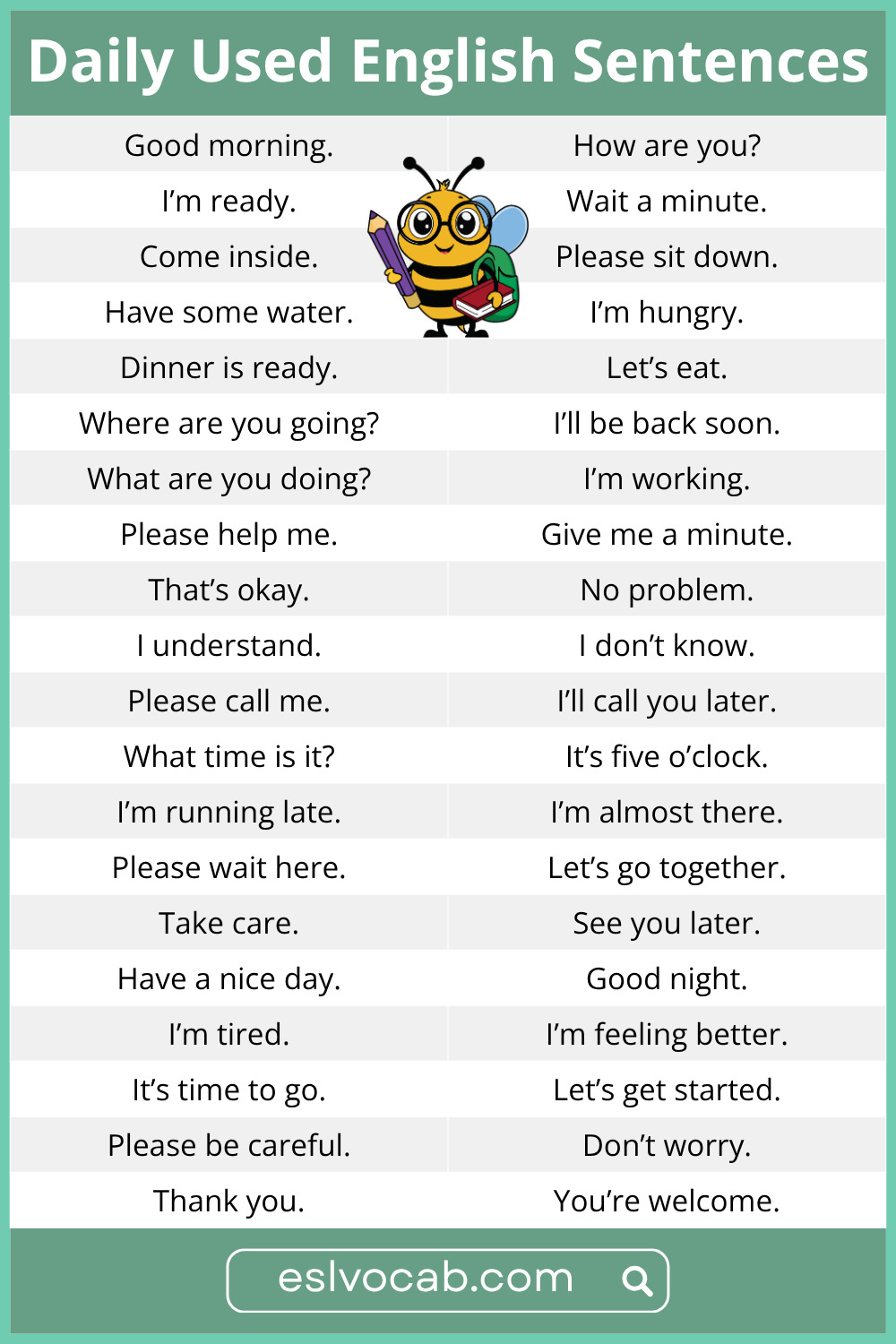
Daily use sentences cover short expressions that appear repeatedly at home, during routines, and while talking with family or friends.
| Good morning. | How are you? |
| I’m ready. | Wait a minute. |
| Come inside. | Please sit down. |
| Have some water. | I’m hungry. |
| Dinner is ready. | Let’s eat. |
| Where are you going? | I’ll be back soon. |
| What are you doing? | I’m working. |
| Please help me. | Give me a minute. |
| That’s okay. | No problem. |
| I understand. | I don’t know. |
| Please call me. | I’ll call you later. |
| What time is it? | It’s five o’clock. |
| I’m running late. | I’m almost there. |
| Please wait here. | Let’s go together. |
| Take care. | See you later. |
| Have a nice day. | Good night. |
| I’m tired. | I’m feeling better. |
| It’s time to go. | Let’s get started. |
| Please be careful. | Don’t worry. |
| Thank you. | You’re welcome. |
Morning Sentences
Morning conversations often mention waking up, getting ready, eating breakfast, checking time, and leaving home for work or school.
- Good morning.
- Did you sleep well?
- I slept well.
- I didn’t sleep much.
- What time did you wake up?
- I woke up at seven.
- I’m still tired.
- I need five more minutes.
- It’s time to get up.
- I’m getting ready.
- I’m taking a shower.
- Breakfast is ready.
- What do you want for breakfast?
- I want some coffee.
- I’m making breakfast.
- Where are my keys?
- I can’t find my phone.
- I’m leaving now.
- Have a good day.
- See you tonight.
About Family Sentences You Should Know
Family conversations often include names, relationships, routines, meals, plans, work, school, and household activities shared by relatives.
- This is my mother.
- This is my father.
- I have two brothers.
- I have one sister.
- My brother is at school.
- My sister is working.
- My parents are at home.
- My family lives nearby.
- We have dinner together.
- My mother is cooking.
- My father is reading.
- My brother is watching TV.
- My sister is doing homework.
- We visit our grandparents.
- My family likes traveling.
- We usually eat together.
- My parents work during the week.
- My brother plays soccer.
- My sister likes music.
- I love my family.
Home Activities English Sentences
Home activities include cooking, cleaning, washing, studying, resting, watching television, and completing small household tasks.
- I’m cleaning the kitchen.
- I’m washing the dishes.
- I’m making dinner.
- I’m doing the laundry.
- I’m cleaning my room.
- Please close the door.
- Please open the window.
- Turn on the light.
- Turn off the television.
- Where is the remote?
- The room is cold.
- The room is warm.
- I need a towel.
- The bathroom is busy.
- Dinner is almost ready.
- Please set the table.
- Can you help me?
- I’ll clean later.
- I’m studying in my room.
- I’m going to bed.
Daily Evening Conversational Sentences in English
Evening conversations usually involve returning home, eating dinner, discussing the day, relaxing, and preparing for bedtime.
- I’m home.
- How was your day?
- My day was good.
- I’m very tired.
- What’s for dinner?
- Dinner smells good.
- Let’s eat together.
- How was work?
- How was school?
- Did you finish your work?
- I finished everything.
- I need to relax.
- Let’s watch a movie.
- Do you want some tea?
- I’m not hungry.
- I’ll clean the kitchen.
- What are you doing tomorrow?
- I have work tomorrow.
- I’m going to bed soon.
- Good night.
English Sentences for Everyday Situations
Everyday situations require different sentence patterns because people communicate differently at restaurants, stores, transportation stops, workplaces, and public places.
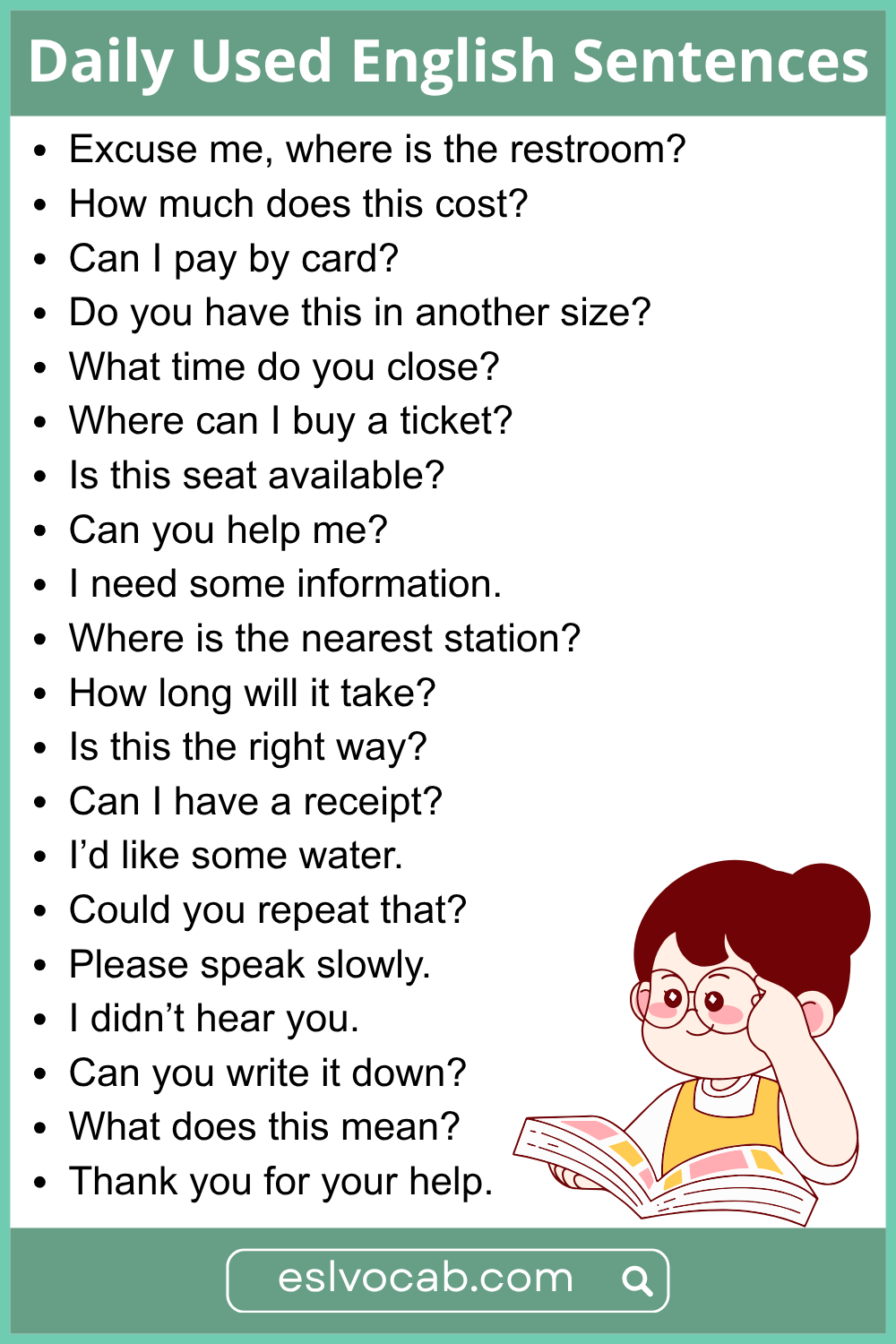
- Excuse me, where is the restroom?
- How much does this cost?
- Can I pay by card?
- Do you have this in another size?
- What time do you close?
- Where can I buy a ticket?
- Is this seat available?
- Can you help me?
- I need some information.
- Where is the nearest station?
- How long will it take?
- Is this the right way?
- Can I have a receipt?
- I’d like some water.
- Could you repeat that?
- Please speak slowly.
- I didn’t hear you.
- Can you write it down?
- What does this mean?
- Thank you for your help.
Restaurant English Sentences for Daily Use
Restaurant conversations commonly involve ordering food, asking about prices, choosing meals, requesting changes, and paying the bill.
- A table for two, please.
- Can we sit here?
- Can I see the menu?
- What do you recommend?
- I’d like a burger.
- I’ll have the chicken.
- Can I have some water?
- I’d like a coffee.
- Can I get this without onions?
- Is this spicy?
- What comes with the meal?
- Can we order now?
- We’re ready to order.
- Can I have another napkin?
- Could we have some ketchup?
- This food is delicious.
- Can I have the check?
- Can we split the bill?
- Can I pay by card?
- Thank you for the meal.
Public Transport English Sentences Used in Daily Life
Public transportation conversations often involve buses, trains, stations, tickets, schedules, stops, directions, and travel times.
- Where is the bus stop?
- Where is the train station?
- Which bus goes downtown?
- Does this train go to Boston?
- What time is the next bus?
- How much is a ticket?
- Where can I buy a ticket?
- Is this seat taken?
- When is the next train?
- How long is the trip?
- Where should I get off?
- Does this bus stop near the mall?
- Is this the right platform?
- Which line should I take?
- I need to go downtown.
- Please tell me when we arrive.
- Is the train late?
- The bus is crowded.
- I missed my bus.
- Thank you for your help.
Common Sentences for Real Conversations
Real conversations often move between questions, answers, requests, and directions. Learning these patterns gives learners practical ways to keep short conversations moving.
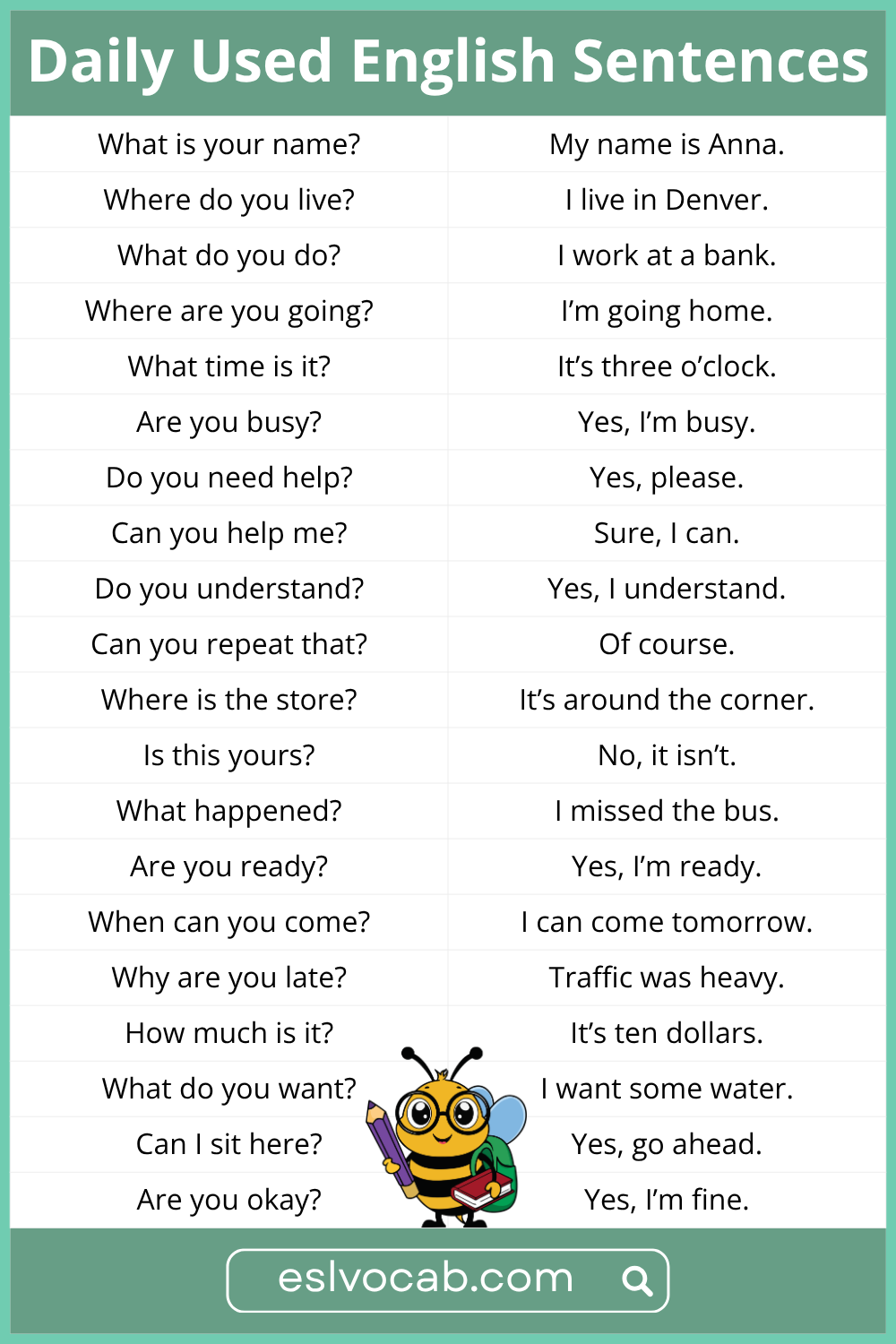
| What is your name? | My name is Anna. |
| Where do you live? | I live in Denver. |
| What do you do? | I work at a bank. |
| Where are you going? | I’m going home. |
| What time is it? | It’s three o’clock. |
| Are you busy? | Yes, I’m busy. |
| Do you need help? | Yes, please. |
| Can you help me? | Sure, I can. |
| Do you understand? | Yes, I understand. |
| Can you repeat that? | Of course. |
| Where is the store? | It’s around the corner. |
| Is this yours? | No, it isn’t. |
| What happened? | I missed the bus. |
| Are you ready? | Yes, I’m ready. |
| When can you come? | I can come tomorrow. |
| Why are you late? | Traffic was heavy. |
| How much is it? | It’s ten dollars. |
| What do you want? | I want some water. |
| Can I sit here? | Yes, go ahead. |
| Are you okay? | Yes, I’m fine. |
Asking Questions in English
Questions help speakers request information about people, places, times, actions, prices, reasons, and choices during ordinary conversations.
- What is your name?
- Where do you live?
- Where are you going?
- What are you doing?
- What time is it?
- When will you arrive?
- Who is that?
- Who called me?
- Why are you late?
- Why are you tired?
- How are you?
- How much is this?
- How many do you need?
- How long will it take?
- How far is the station?
- Can you help me?
- Could you repeat that?
- Do you need anything?
- Are you ready?
- Did you eat breakfast?
Giving Answers
Answers can be short or complete depending on the question. Daily conversations often use direct answers followed by one useful detail.
- My name is John.
- I live in Chicago.
- I’m going home.
- I’m working right now.
- It’s seven o’clock.
- I’ll arrive at six.
- That’s my brother.
- Sarah called you.
- I missed the bus.
- I’m tired today.
- I’m fine, thank you.
- It costs ten dollars.
- I need two.
- It will take an hour.
- It’s two miles away.
- Yes, I can help.
- Sure, I’ll repeat it.
- No, I don’t need anything.
- Yes, I’m ready.
- Yes, I ate breakfast.
Making Requests
Requests allow speakers to ask for help, objects, information, permission, or small actions in a polite way.
- Please help me.
- Can you help me?
- Could you help me?
- Please open the door.
- Can you close the window?
- Could you pass the salt?
- Can I borrow your pen?
- Can I use your phone?
- May I sit here?
- Could you wait a minute?
- Please speak slowly.
- Can you repeat that?
- Could you write it down?
- Please call me later.
- Can you send me the address?
- Could you check this?
- Please give me some water.
- Can you turn off the light?
- Could you tell me the time?
- Please wait here.
Giving Directions
Directions explain where a person should go and often use location words such as left, right, straight, near, behind, and across.
- Go straight ahead.
- Turn left here.
- Turn right at the corner.
- Keep going straight.
- Take the next left.
- Take the second right.
- The store is on your left.
- The bank is on your right.
- It’s across the street.
- It’s next to the library.
- It’s behind the school.
- It’s near the station.
- Walk two blocks.
- Cross the street.
- Follow this road.
- Take this bus.
- Get off at the next stop.
- The station is nearby.
- You are going the wrong way.
- You’re almost there.
Daily English Sentences for Social Situations
Social conversations include plans, invitations, greetings, casual questions, meeting arrangements, and polite goodbyes between people.
| Social Sentence | Social Sentence |
|---|---|
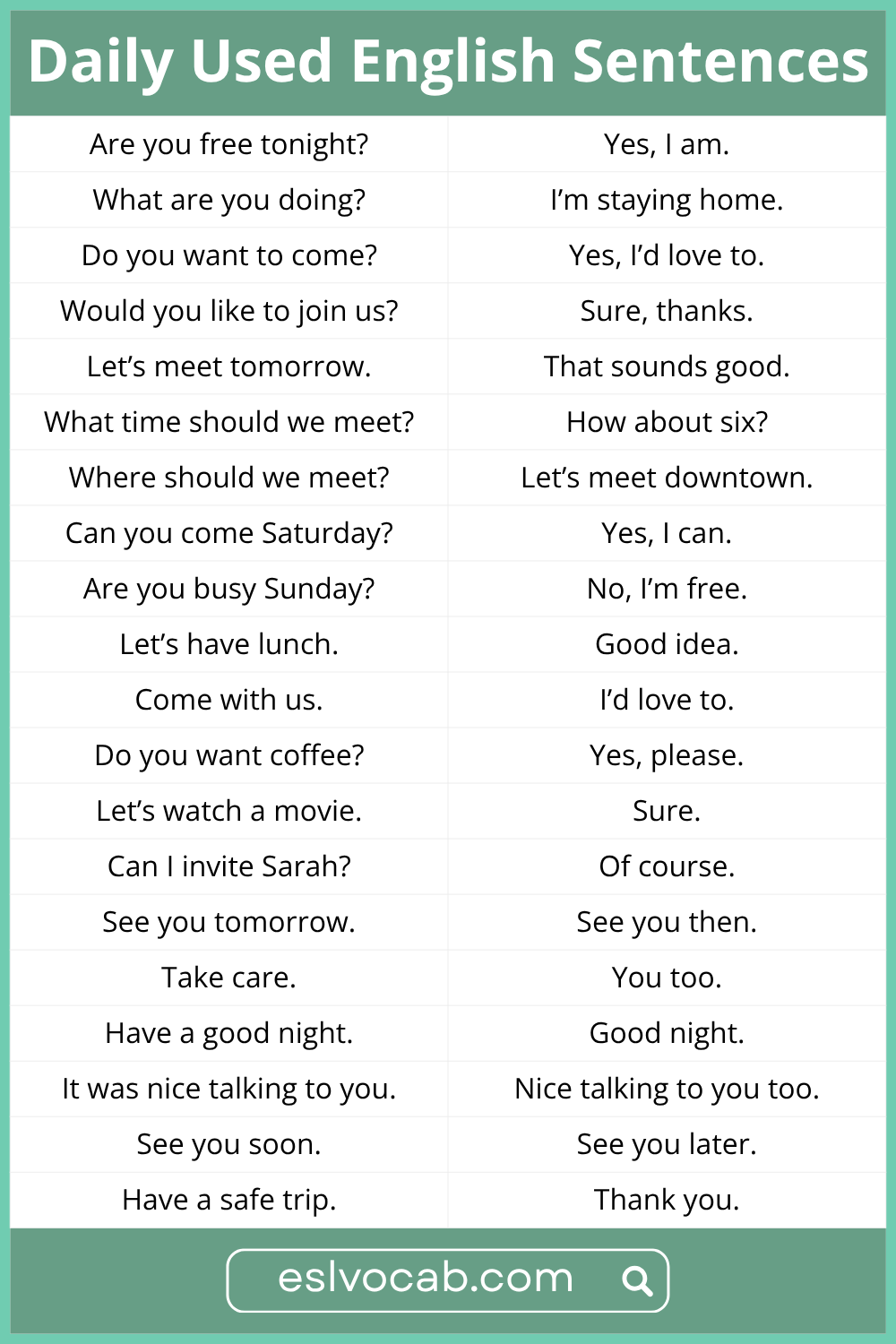
| Are you free tonight? | Yes, I am. |
| What are you doing? | I’m staying home. |
| Do you want to come? | Yes, I’d love to. |
| Would you like to join us? | Sure, thanks. |
| Let’s meet tomorrow. | That sounds good. |
| What time should we meet? | How about six? |
| Where should we meet? | Let’s meet downtown. |
| Can you come Saturday? | Yes, I can. |
| Are you busy Sunday? | No, I’m free. |
| Let’s have lunch. | Good idea. |
| Come with us. | I’d love to. |
| Do you want coffee? | Yes, please. |
| Let’s watch a movie. | Sure. |
| Can I invite Sarah? | Of course. |
| See you tomorrow. | See you then. |
| Take care. | You too. |
| Have a good night. | Good night. |
| It was nice talking to you. | Nice talking to you too. |
| See you soon. | See you later. |
| Have a safe trip. | Thank you. |
Inviting Someone
Invitations help speakers ask another person to join an activity, meal, event, visit, or casual gathering.
- Would you like to come?
- Do you want to join us?
- Can you come with me?
- Would you like to have dinner?
- Do you want to get coffee?
- Would you like to watch a movie?
- Do you want to come over?
- Can you join us for lunch?
- Would you like to come Saturday?
- Do you want to go downtown?
- Would you like to visit us?
- Can I invite you to dinner?
- Do you want to come to the party?
- Would you like to join my family?
- Can you come after work?
- Do you want to go shopping?
- Would you like to have some tea?
- Can you meet us at six?
- Would you like to come along?
- I hope you can come.
Saying Goodbye in English
Goodbyes can be brief, warm, formal, or casual depending on the relationship and situation. Different expressions fit different endings.
- Goodbye.
- Bye.
- See you later.
- See you soon.
- See you tomorrow.
- See you next week.
- Talk to you later.
- I’ll call you later.
- Take care.
- Have a good day.
- Have a good evening.
- Have a good night.
- Have a safe trip.
- Enjoy your weekend.
- Thanks for coming.
- It was nice seeing you.
- It was nice talking to you.
- I’ll see you around.
- Good night.
- Bye for now.
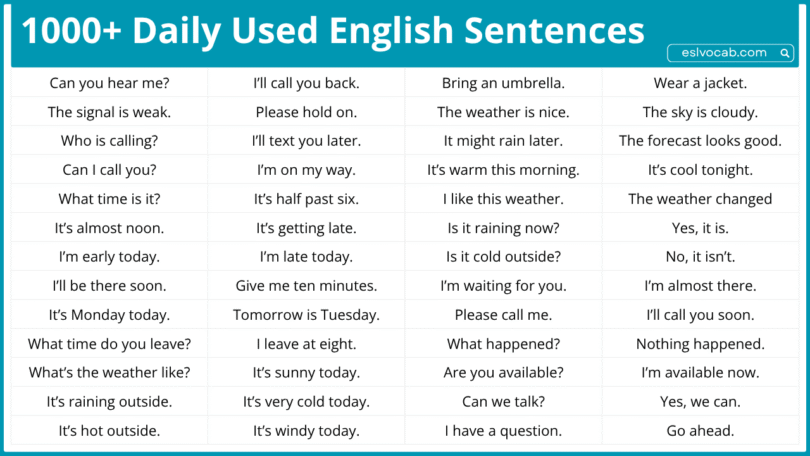
Practical English Sentences for Everyday Life
Practical daily sentences cover situations where people talk about calls, schedules, time, weather, appointments, and ordinary plans.
| Practical Sentence | Practical Sentence |
|---|---|
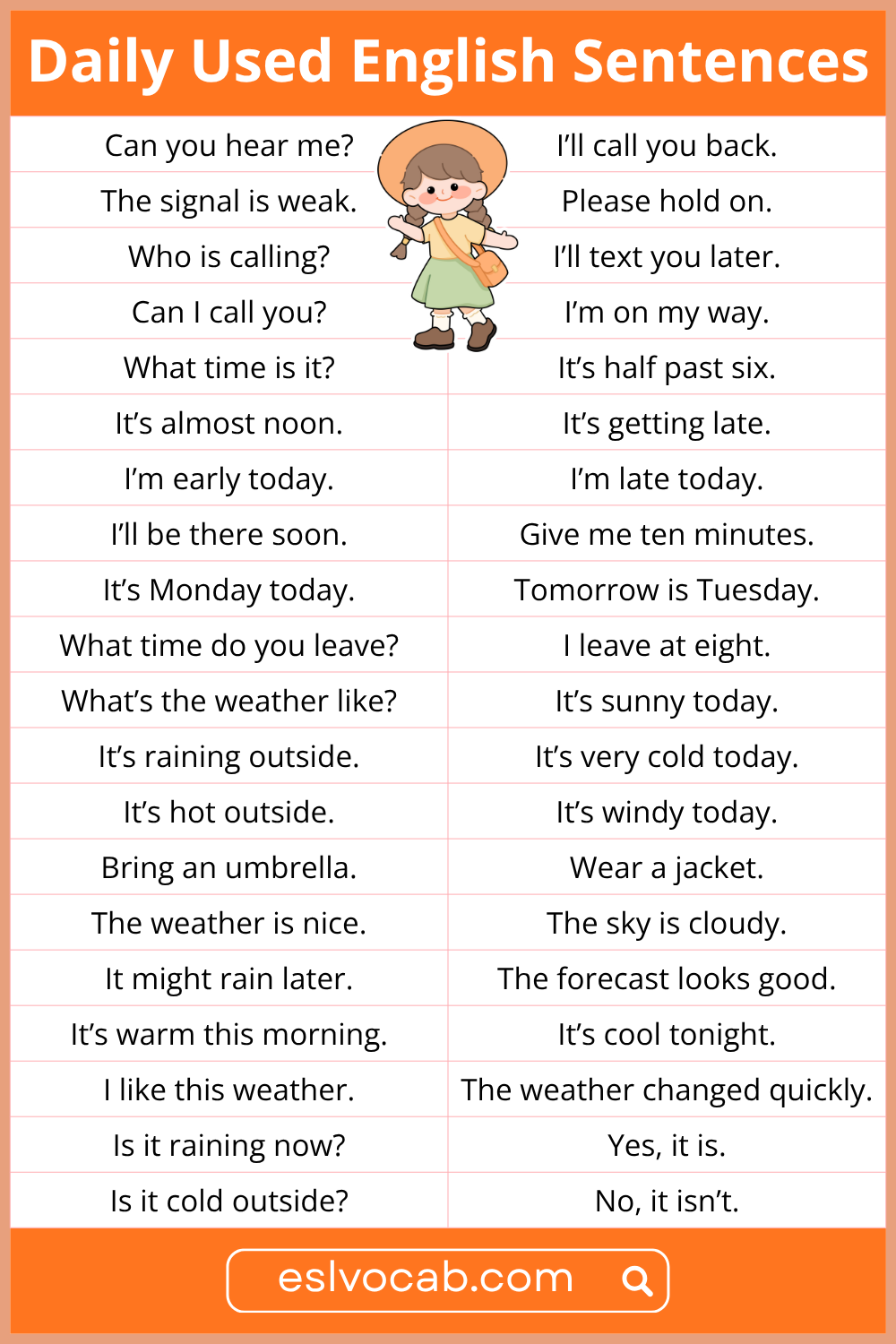
| Can you hear me? | I’ll call you back. |
| The signal is weak. | Please hold on. |
| Who is calling? | I’ll text you later. |
| Can I call you? | I’m on my way. |
| What time is it? | It’s half past six. |
| It’s almost noon. | It’s getting late. |
| I’m early today. | I’m late today. |
| I’ll be there soon. | Give me ten minutes. |
| It’s Monday today. | Tomorrow is Tuesday. |
| What time do you leave? | I leave at eight. |
| What’s the weather like? | It’s sunny today. |
| It’s raining outside. | It’s very cold today. |
| It’s hot outside. | It’s windy today. |
| Bring an umbrella. | Wear a jacket. |
| The weather is nice. | The sky is cloudy. |
| It might rain later. | The forecast looks good. |
| It’s warm this morning. | It’s cool tonight. |
| I like this weather. | The weather changed quickly. |
| Is it raining now? | Yes, it is. |
| Is it cold outside? | No, it isn’t. |
| I’m waiting for you. | I’m almost there. |
| Please call me. | I’ll call you soon. |
| What happened? | Nothing happened. |
| Are you available? | I’m available now. |
| Can we talk? | Yes, we can. |
| I have a question. | Go ahead. |
| I need some help. | I’ll help you. |
| Are you busy? | I’m free now. |
| Let’s talk later. | That’s fine with me. |
| I’ll see you tonight. | See you tonight. |
Talking on the Phone
Phone conversations often require short sentences for greetings, checking connections, asking for someone, ending calls, and arranging another call.
- Hello, this is David.
- Hi, this is Emma.
- Can I speak to John?
- Who is calling, please?
- How are you?
- Can you hear me?
- I can hear you.
- The signal is weak.
- You are breaking up.
- Please speak louder.
- Can you repeat that?
- Please hold on.
- I’ll call you back.
- I can’t talk right now.
- Can I call you later?
- What time should I call?
- I’ll text you the details.
- Thanks for calling.
- It was nice talking to you.
- Talk to you later.
Talking About Time in English
Time sentences help speakers arrange appointments, describe routines, mention delays, and say when events begin or finish.
- What time is it?
- It’s three o’clock.
- It’s half past three.
- It’s quarter past three.
- It’s quarter to four.
- It’s almost four.
- It’s five minutes past four.
- It’s ten minutes to five.
- I wake up at seven.
- I leave at eight.
- I arrive at nine.
- Lunch is at noon.
- Dinner is at six.
- I’ll come at five.
- I’ll be there soon.
- Give me ten minutes.
- I’m running late.
- I’m early today.
- It’s getting late.
- See you tomorrow.
Talking About the Weather
Weather conversations often mention temperature, sunlight, rain, wind, clouds, seasons, and plans affected by outdoor conditions.
- It’s sunny today.
- It’s cloudy today.
- It’s raining outside.
- It’s snowing outside.
- It’s very cold.
- It’s very hot.
- It’s warm today.
- It’s cool this morning.
- It’s windy today.
- The sky is clear.
- The sky is cloudy.
- It might rain later.
- Bring an umbrella.
- Wear a jacket.
- The weather is nice.
- The weather changed quickly.
- It’s colder than yesterday.
- It’s warmer today.
- I like this weather.
- What’s the forecast for tomorrow?
500 Short English Sentences for Daily Conversations
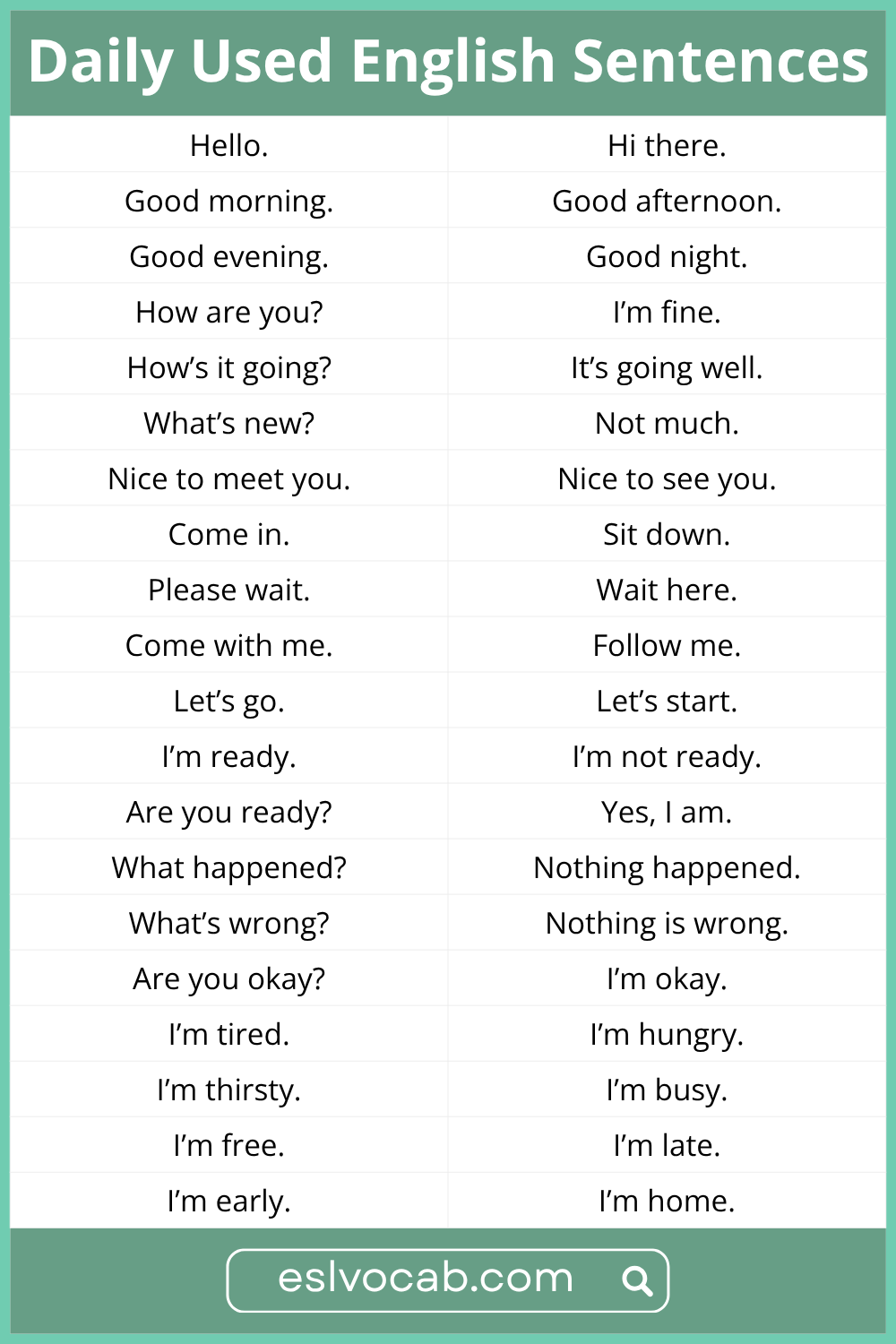
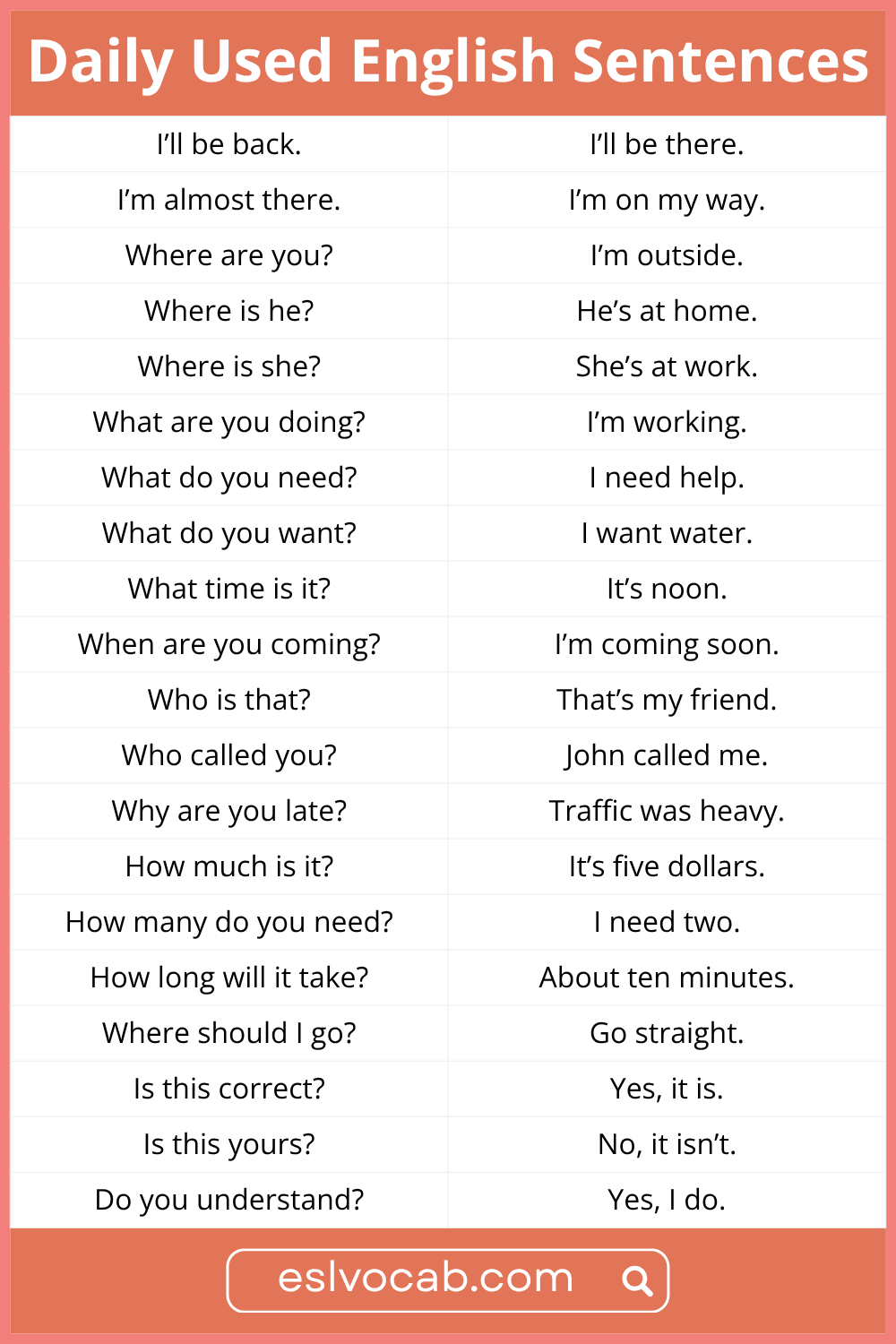
Short sentences are useful when learners need quick responses during ordinary conversations. The following collection covers greetings, home, school, work, shopping, travel, feelings, questions, requests, and social situations.
| Short Sentence | Short Sentence |
|---|---|
| Hello. | Hi there. |
| Good morning. | Good afternoon. |
| Good evening. | Good night. |
| How are you? | I’m fine. |
| How’s it going? | It’s going well. |
| What’s new? | Not much. |
| Nice to meet you. | Nice to see you. |
| Come in. | Sit down. |
| Please wait. | Wait here. |
| Come with me. | Follow me. |
| Let’s go. | Let’s start. |
| I’m ready. | I’m not ready. |
| Are you ready? | Yes, I am. |
| What happened? | Nothing happened. |
| What’s wrong? | Nothing is wrong. |
| Are you okay? | I’m okay. |
| I’m tired. | I’m hungry. |
| I’m thirsty. | I’m busy. |
| I’m free. | I’m late. |
| I’m early. | I’m home. |
| I’m leaving. | I’m coming. |
| I’ll be back. | I’ll be there. |
| I’m almost there. | I’m on my way. |
| Where are you? | I’m outside. |
| Where is he? | He’s at home. |
| Where is she? | She’s at work. |
| What are you doing? | I’m working. |
| What do you need? | I need help. |
| What do you want? | I want water. |
| What time is it? | It’s noon. |
| When are you coming? | I’m coming soon. |
| Who is that? | That’s my friend. |
| Who called you? | John called me. |
| Why are you late? | Traffic was heavy. |
| How much is it? | It’s five dollars. |
| How many do you need? | I need two. |
| How long will it take? | About ten minutes. |
| Where should I go? | Go straight. |
| Is this correct? | Yes, it is. |
| Is this yours? | No, it isn’t. |
| Do you understand? | Yes, I do. |
| Do you agree? | Yes, I agree. |
| Can you help me? | Sure, I can. |
| Could you wait? | Of course. |
| Can I sit here? | Yes, go ahead. |
| Can I use this? | Yes, you can. |
| May I come in? | Yes, please. |
| Could you repeat that? | Sure, I will. |
| Please speak slowly. | I’ll speak slowly. |
| Please write it down. | Okay, I will. |
| Call me later. | I’ll call you. |
| Text me later. | I will text you. |
| Give me a minute. | Take your time. |
| Don’t worry. | It’s okay. |
| No problem. | That’s fine. |
| That’s right. | That’s wrong. |
| I understand. | I don’t understand. |
| I know. | I don’t know. |
| I remember. | I don’t remember. |
| I agree. | I don’t agree. |
| I like it. | I don’t like it. |
| I want it. | I don’t want it. |
| I need it. | I don’t need it. |
| I can help. | I can’t help. |
| I can come. | I can’t come. |
| I feel good. | I feel tired. |
| I feel better. | I feel sick. |
| I’m happy. | I’m sad. |
| I’m excited. | I’m worried. |
| I’m sure. | I’m not sure. |
| I’m ready. | I’m not ready. |
| It’s mine. | It’s yours. |
| It’s here. | It’s there. |
| It’s nearby. | It’s far away. |
| It’s open. | It’s closed. |
| It’s easy. | It’s difficult. |
| It’s hot. | It’s cold. |
| It’s sunny. | It’s cloudy. |
| It’s raining. | It’s snowing. |
| Let’s eat. | Let’s drink. |
| Let’s talk. | Let’s wait. |
| Let’s go home. | Let’s go outside. |
| Let’s meet tomorrow. | Let’s meet tonight. |
| Do you want coffee? | Yes, please. |
| Would you like tea? | No, thank you. |
| Are you hungry? | Yes, I’m hungry. |
| Are you thirsty? | Yes, I’m thirsty. |
| Did you eat? | Yes, I did. |
| Did you sleep well? | Yes, I did. |
| How was your day? | It was good. |
| How was work? | It was busy. |
| How was school? | It was fine. |
| See you later. | See you soon. |
| Take care. | You too. |
| Have a good day. | Thank you. |
| Have a good night. | Good night. |
Sentences for Daily Used in English PDF
FAQs about Daily Sentences
They are common sentences for greetings, questions, requests, plans, family conversations, shopping, transportation, meals, and everyday social situations.
Start with 10 to 20 sentences daily, then practice them in short conversations until their patterns become familiar.
Read each sentence aloud, write your own variations, practice short dialogues, and use the sentences during suitable daily situations.
You can learn 30 useful English words every day, such as happy, tired, hungry, speak, listen, learn, teach, ask, answer, help, need, want, buy, sell, give, take, bring, go, come, wait, and remember.
Some common daily-life sentences are “Good morning!”, “How are you?”, “What are you doing?”, “Can you help me?”, and “See you tomorrow.”
Complete sentences give learners useful grammar patterns, while individual words help them create additional sentences.
Short sentences such as “How are you?”, “I am ready,” “Please help me,” and “See you later” are useful starting points.
Takeaway for Learners
Daily English becomes easier to practice when sentences are grouped by situation. Start with greetings and short questions, then practice requests, answers, plans, family conversations, transportation, restaurants, phone calls, time, and weather. Reuse familiar sentence patterns with different words so one sentence structure can become several useful expressions.
Read more