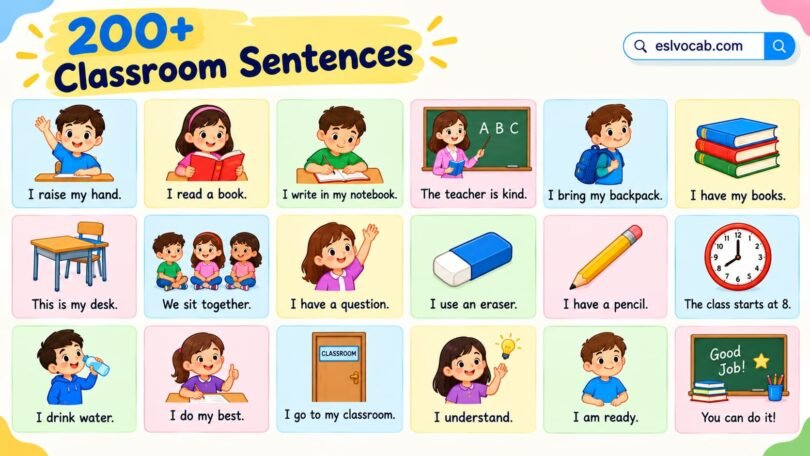

Classroom sentences help children and students communicate naturally during lessons, ask for help, follow instructions, and take part in school activities. Learning common classroom English makes it easier to speak with teachers and classmates. These sentences are short, practical, and useful for everyday school situations.
What Are Sentences for Kids for Classroom?
Classroom sentences for kids are simple English expressions students use while learning at school. They help children communicate with teachers, classmates, and other students during lessons and activities.
For young learners, classroom English usually includes sentences for asking questions, answering the teacher, requesting something, following instructions, and talking about schoolwork.
For example, a child may say:
- “Can I come in?”
- “May I ask a question?”
- “I don’t understand.”
- “Can you help me?”
- “I have finished my work.”
Learning these common expressions gives children practical English they can use instead of memorizing isolated words. Teachers can also introduce a few sentences at a time and encourage students to use them naturally during the school day.
Basic Classroom Sentences for Students in English
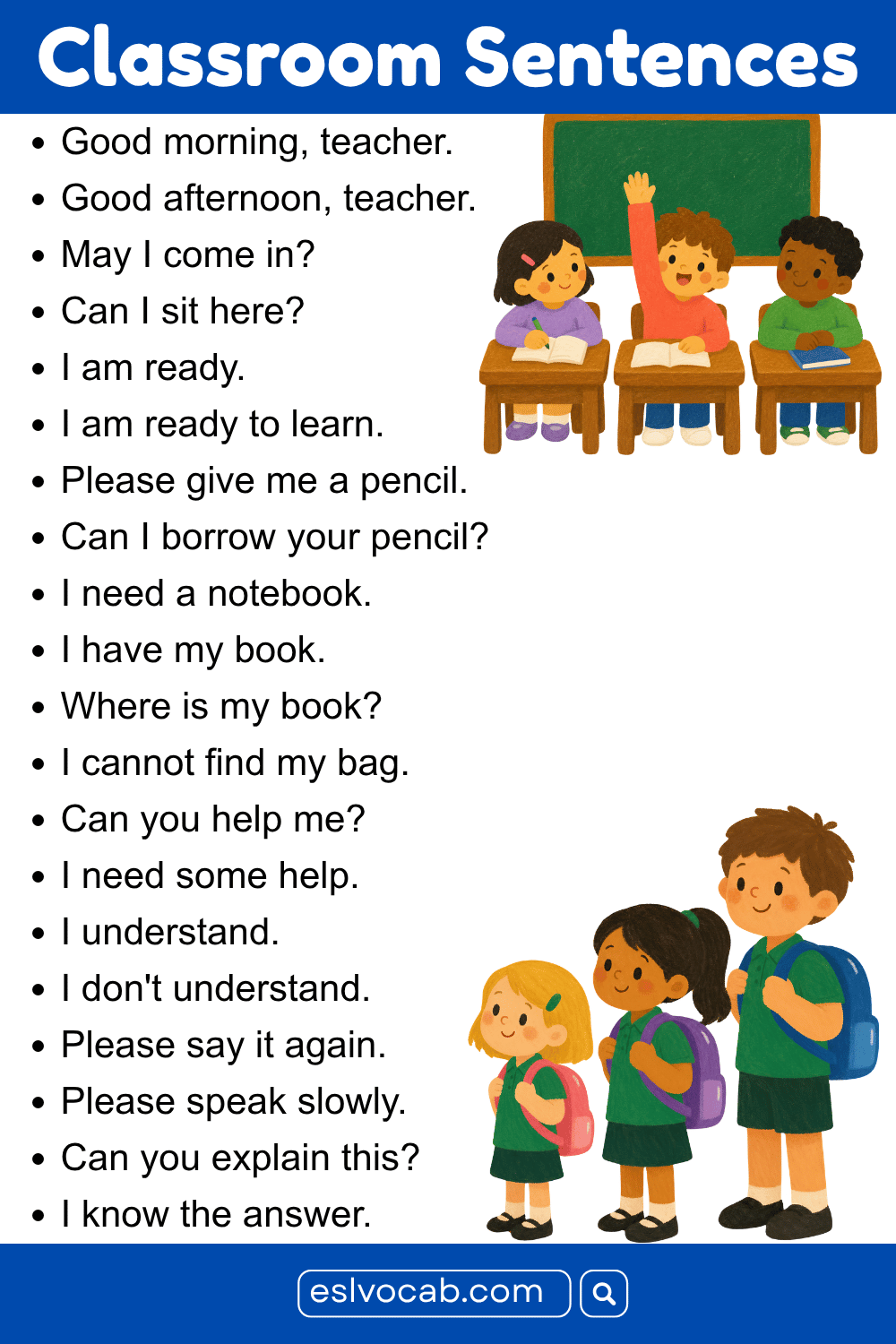
Basic classroom sentences are useful expressions students can use from the moment they enter the classroom until the lesson ends. They cover common needs such as greetings, requests, answers, and classroom instructions.
- Good morning, teacher.
- Good afternoon, teacher.
- May I come in?
- Can I sit here?
- I am ready.
- I am ready to learn.
- Please give me a pencil.
- Can I borrow your pencil?
- I need a notebook.
- I have my book.
- Where is my book?
- I cannot find my bag.
- Can you help me?
- I need some help.
- I understand.
- I don’t understand.
- Please say it again.
- Please speak slowly.
- Can you explain this?
- I know the answer.
- I don’t know the answer.
- May I answer?
- Can I try?
- I have finished.
- I am still working.
- What should I do?
- Is this correct?
- Can you check my work?
- May I go outside?
- Thank you, teacher.
Simple Sentences for Classroom for Kids
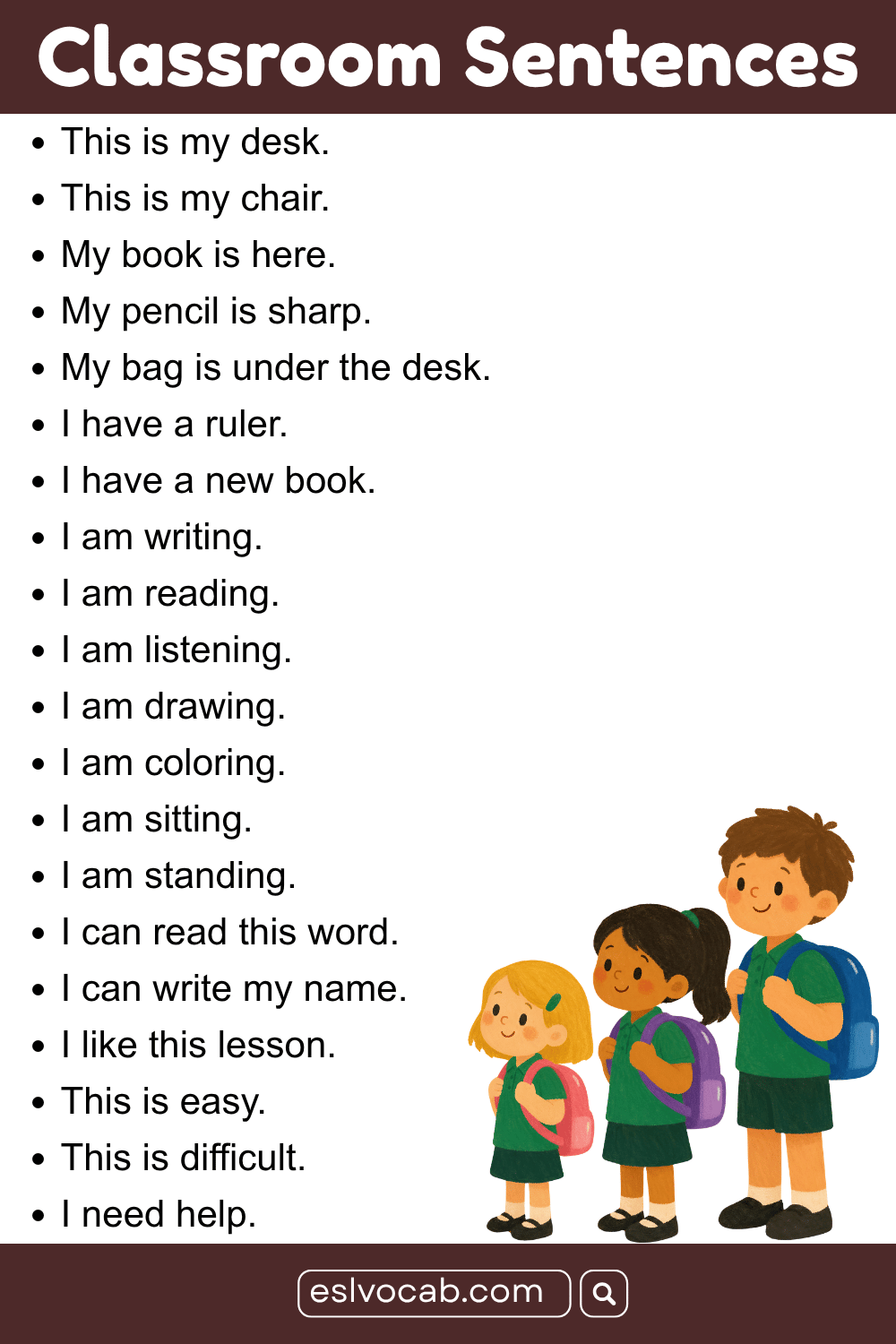
Simple classroom sentences make it easier for young children to communicate without worrying about complicated English. These sentences use familiar words and can be practiced during everyday classroom routines.
- This is my desk.
- This is my chair.
- My book is here.
- My pencil is sharp.
- My bag is under the desk.
- I have a ruler.
- I have a new book.
- I am writing.
- I am reading.
- I am listening.
- I am drawing.
- I am coloring.
- I am sitting.
- I am standing.
- I can read this word.
- I can write my name.
- I like this lesson.
- This is easy.
- This is difficult.
- I need help.
- Please wait for me.
- Please help me.
- I am done.
- I need more time.
- Where is my pencil?
- Where is the teacher?
- What is this word?
- What does this mean?
- Can I use this?
- Thank you for helping me.
Classroom English Sentences for Teachers
Teachers use classroom English to guide students, explain lessons, give instructions, check understanding, and keep activities organized. Clear and simple sentences are especially helpful when teaching young English learners.
- Good morning, everyone.
- How are you today?
- Please sit down.
- Please stand up.
- Open your books.
- Close your books.
- Take out your pencils.
- Look at the board.
- Listen carefully.
- Please be quiet.
- Raise your hand.
- Wait for your turn.
- Repeat after me.
- Say it again.
- Read this sentence.
- Write your name here.
- Write the answer.
- Circle the correct answer.
- Underline the word.
- Work with a partner.
- Work in small groups.
- Talk to your partner.
- Please come to the board.
- Who knows the answer?
- Can you answer this question?
- Does everyone understand?
- Do you need help?
- Check your answers.
- Finish your work.
- Well done, everyone.
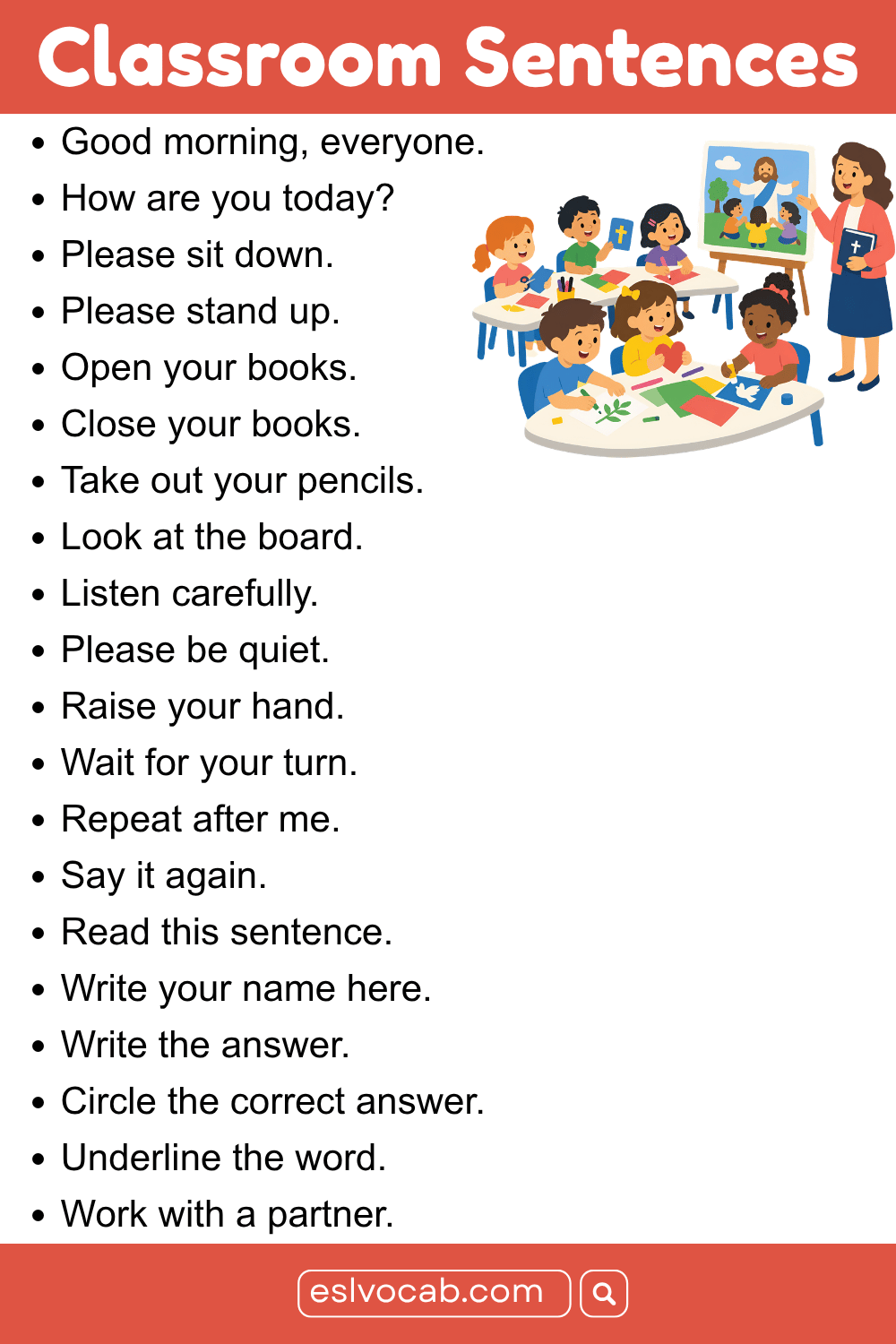
Teachers can make these expressions part of their normal teaching routine. Instead of translating every instruction, they can repeat the same simple English sentence while demonstrating the action. Over time, students begin to understand the meaning through context.
Asking Questions in English in the Classroom
Asking questions is an important part of classroom communication. Students need simple question sentences to understand lessons, ask for clarification, and participate in discussions.
Here are useful questions students can practice:
- What is this?
- What does this word mean?
- How do I spell this word?
- How do I say this word?
- How do you spell it?
- Can you explain it?
- Can you say it again?
- Can you speak slowly?
- Can you help me?
- Is this correct?
- Is my answer right?
- What page are we on?
- Which page should I read?
- What should I write?
- Where should I write?
- When is the homework due?
- What is the homework?
- Can I ask a question?
- Can I answer the question?
- Can I use a pencil?
- Can I borrow a ruler?
- Can I go to the bathroom?
- Can I drink some water?
- Can I open the window?
- Can I close the door?
- Can I sit here?
- Can I work with my friend?
- Should I write this?
- Do we need a book?
- Are we finished?
Teachers can encourage students to ask these questions instead of staying quiet when they do not understand something. This helps children become more comfortable using English in real classroom situations.
English Sentences for Classroom Activities
Classroom activities give children many opportunities to use English naturally. Whether students are reading, writing, drawing, playing a game, or working in groups, simple sentences can help them communicate during the activity.
Reading Activities
- I am reading a book.
- I can read this sentence.
- Please read with me.
- What is this word?
- I know this word.
Writing Activities
- I am writing my name.
- I need a pencil.
- What should I write?
- Is my spelling correct?
- I have finished writing.
Drawing and Coloring
- I am drawing a house.
- I am coloring the tree.
- What color should I use?
- Can I have a blue crayon?
- My picture is finished.
Group Activities
- Let’s work together.
- Can I join your group?
- What are we doing?
- You can go first.
- It is my turn.
- Let’s share the pencils.
- We can do it together.
- I have an idea.
- What do you think?
- Good idea!
Classroom Games
- Let’s play a game.
- Whose turn is it?
- It is my turn.
- Your turn now.
- I know the answer.
- I got it right.
- Let’s try again.
- That was fun.
- I am ready.
- Can we play again?
Classroom Conversation Between Teacher and Student
Short teacher-student conversations help children see how classroom sentences work in real situations. Instead of learning expressions separately, students can practice them as natural exchanges.
Conversation 1: Asking for Help
Teacher: What are you doing?
Student: I am doing my English work.
Teacher: Do you need help?
Student: Yes, please. I don’t understand this question.
Teacher: No problem. Let’s look at it together.
Student: Thank you, teacher.
Conversation 2: Asking a Question
Student: May I ask a question?
Teacher: Yes, of course.
Student: What does this word mean?
Teacher: It means “happy.”
Student: Thank you.
Teacher: You’re welcome.
Conversation 3: Borrowing a Pencil
Student: Can I borrow a pencil?
Teacher: Yes. Here you are.
Student: Thank you.
Teacher: You’re welcome.
Conversation 4: Finishing Work
Teacher: Have you finished your work?
Student: Yes, I have.
Teacher: Please check your answers.
Student: Okay, teacher.
Teacher: Well done.
Student: Thank you.
Conversation 5: Classroom Instruction
Teacher: Please open your books.
Student: Which page?
Teacher: Page ten.
Student: Okay.
Teacher: Now read the first sentence.
Student: Yes, teacher.
Short English Sentences for Classroom at School
Short English sentences are easy for children to remember and use throughout the school day. Students can practice these expressions during lessons, breaks, group work, and other common school situations.
- Good morning.
- Hello, teacher.
- Please come in.
- Please sit down.
- Stand up, please.
- Listen to me.
- Look at the board.
- Open your book.
- Close your book.
- Read this.
- Write this.
- Say it again.
- Please wait.
- Be quiet, please.
- Raise your hand.
- I am ready.
- I am listening.
- I understand.
- I don’t understand.
- Please help me.
- I have a question.
- What is this?
- What does it mean?
- Is this correct?
- I know the answer.
- I don’t know.
- Can I try?
- I am finished.
- See you tomorrow.
- Goodbye, teacher.
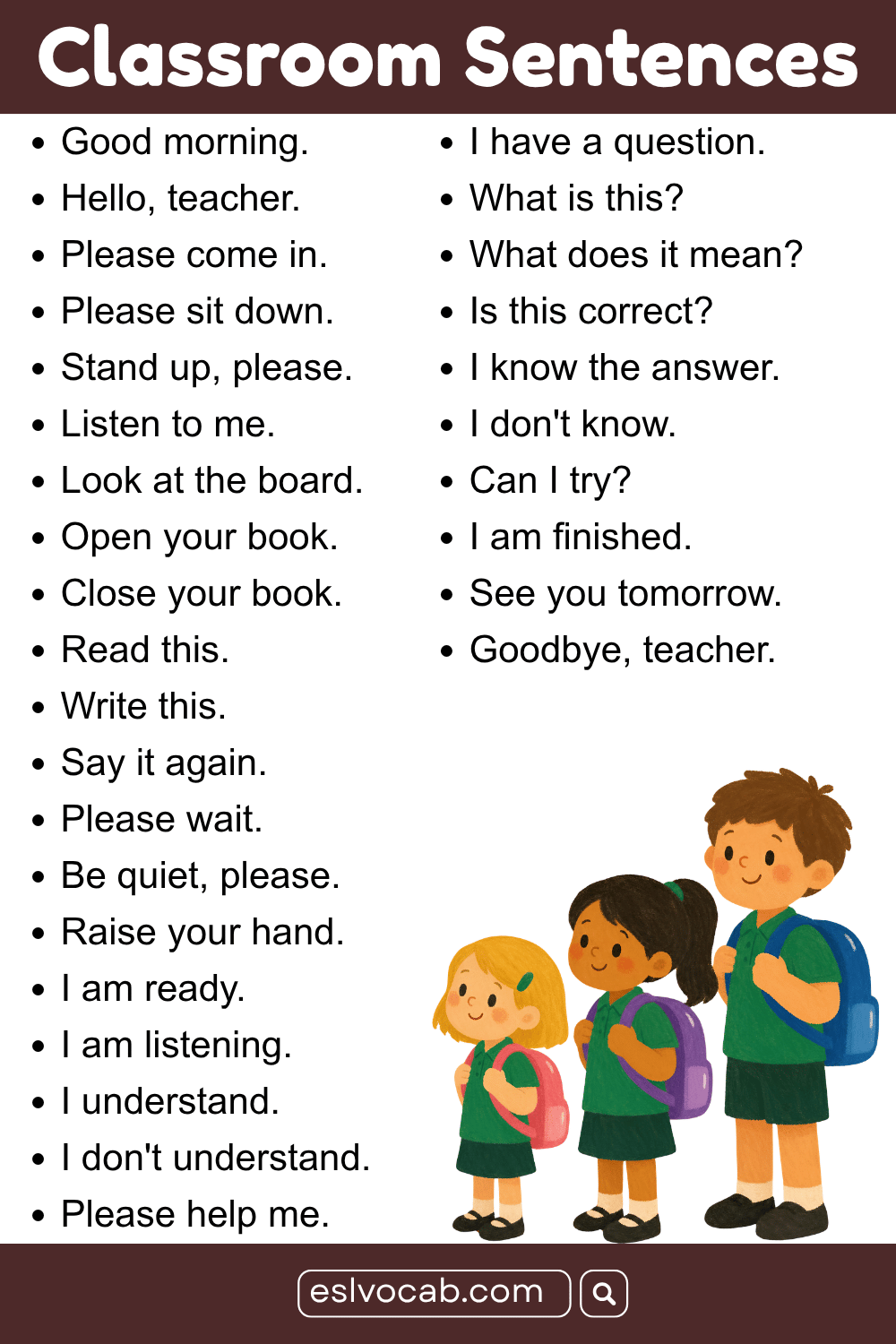
Regular practice makes these short expressions easier to remember. Parents can practice them at home, while teachers can use them repeatedly during real classroom activities. Children do not need to memorize a long list at once. Learning five or six sentences and using them every day is a practical place to begin.
Classroom Sentences pdf
FAQs About Classroom Sentences
Classroom sentences are common English expressions used by teachers and students during lessons, activities, discussions, and everyday school routines.
Classroom English sentences help children communicate with teachers and classmates, understand instructions, ask questions, and participate more comfortably in school activities.
Basic examples include “Good morning, teacher,” “May I come in?”, “I don’t understand,” “Can you help me?” and “I have finished my work.”
Teachers commonly say “Open your books,” “Listen carefully,” “Raise your hand,” “Repeat after me,” “Work with a partner,” and “Check your answers.”
Children can practice by repeating short expressions, acting out teacher-student conversations, reading classroom dialogues, and using English during real school activities.
Students can use questions such as “What does this word mean?”, “Can you explain it?”, “Is this correct?”, and “Can you say it again?”
Short classroom sentences include “I am ready,” “Please help me,” “I understand,” “Open your book,” “Look at the board,” and “I am finished.”
Read more